|
|
|||||||
|
Welcome! This Subbotniki.net web site is dedicated to research and information exchange regarding the Subbotniks (Cубботники, Subbotniki).
This web site does not represent any organization, just individuals wishing to promote knowledge and understanding about the Subbotniki. This Subbotniki.net home page consists of an organized collection of links to major articles and original content pertaining to Subbotniki around the world, past and present. Please explore the content here, and send us your comments or questions. New material, links questions and comments are always welcomed and appreciated. In Memory of Bill Aldacushion (1946-2018) Send corrections, suggestions, new information to: Andrei Conovaloff NOTE: The views represented by the content of external links contained or referenced on this web site are not necessarily those of the Subbotniki.net web site coordinators but are included only to present the wide range of views surrounding the Subbotniki so that all this information can be viewed in context. |
|||||||
Contents |
|||||||
|
Click on blue links.
|
|||||||
|
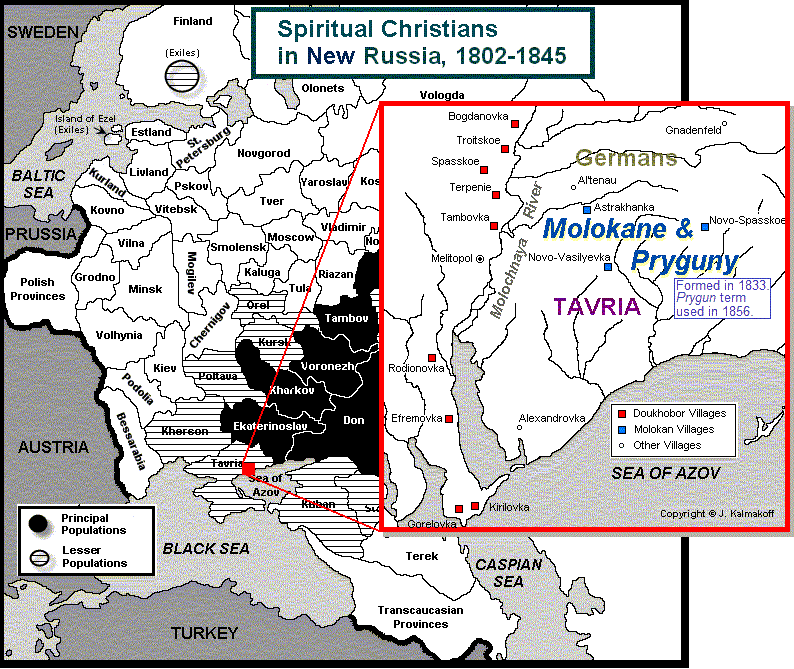
Purpose of this website: Prior to the launch of this web site (April 4, 2005), there was no central source of information on the Subbotniki, nor was information easy to find at that time. As a descendant of Subbotnik and Dukh-i-zhiznik parents in America, I have always wanted to better understand my religious and ethnic heritage. I can remember that my Pivovaroff babunya [Russian diminutive: babushka, grandmother] who was Subbotniki and my Babashoff babunya who was originally Prygun, practiced their religions in different ways and on different days, but beyond that, there were many similarities between them. I have been told by my Subbotnik ancestors that they did not consider themselves to be Jews and originally did not even call themselves Subbotniki. While living in Russia, they met in secret in a member's basement to avoid detection by government authorities and the Orthodox Church. They simply referred to their group as the congregation that met at so-and-so's house. Example: "Pivovarov's meeting" (Russian: Pivovarov sobranie) The moniker Subbotniki was laid upon them by the Orthodox Church due to their observance of the Saturday Sabbath as prescribed in the Old Testament. After immigrating to Los Angeles in the early 1900s, they referred to themselves as Russians or Russian-Americans. In East Los Angeles, now the Boyle Heights district, there was a contention between the Subbotnik and neighboring faiths from Russia (Jews and Spiritual Christians), as described in my Subbotnik Research Report. I am pleased to present the information on this website which I maintained with Andrei Conovaloff, who hosts a similar site about Spiritual Christians. I am grateful for his support, without which this site could not be launched. My goal is to promote understanding and to encourage others to share what they may know about the Subbotniki. Since the Subbotniki have essentially ceased to exist as organized congregations, except in a few pockets of the former Soviet Union, I feel it is important to document what we have found so far. Bill wrote the above before 2016. In 2017, Andrei visited more than 1000 Subbotniki in Portland, Oregon, who arrived after 2000, but Bill was too ill to take the trip. A Russian TV news video was broadcast in 2016 about a large Subbotnik congregation that shared the village of Bonderovo with Molokane in Siberia. Translations and more news in-progress. |
|||||||
1. Subbotniki (Cубботники) — An Introduction |
|||||||
Russian: Subbotniki — субботники. English: Saturday Sabbath Keepers. Subbotniki is the name given to a Sabbath-observing sect in Russia — “Saturday people” — "Sabbath keepers" — “the people of the Law of Moses” — non-Jewish people who obey the Old Testament, hold services on Saturday, and follow many Jewish laws and customs. They are not to be confused with other Sabbath-keepers or Sabbatarians, like “Seventh-Day Baptist,” Church of God, Seventh-day Adventists, etc. (See The Sabbatarian Context discussion below on this web site.) Other spellings in English: "Sobotnikim" and "Subbotnikim" in Israel; "Subotnik", "Subbotnick", "Sobotniki". Several references in Russian and other source material label these people as Judaizers as opposed to calling them Jews. The term Judaizers can be defined: "... predominantly a Christian term. According to the Concise Oxford Dictionary of World Religions this term includes groups such as Jewish Christians, Quartodecimans, Ewostathians, descendants of English Puritanism such as the Seventh-day Adventists and others, who claim the necessity of obedience to the Mosaic Laws which are found in the first five books of the Christian Old Testament." The Russian Orthodox Church punished their heresy — Christian- Judaizers. Only a few Subbotnik congregations with dwindling numbers are known to exist today in Israel, Russia, Armenia and Azerbaijan with some Sabbatarian congregations found in Transylvania and Hungary. Some emigrated to Israel, Europe and the US. See the Sekstanstvo (Sectarian) Bodies: Judaizing Sects for a further discussion of the classification of these sects. Since 2000, thousands of Spiritual Christian Subbotniki from the Former Soviet Union and Eastern Europe, few from Russia, migrated to the USA, about half to the east side of Portland, Oregon, where about 34 congregations are cooperatively sharing 7 meeting halls. The recent immigrants are divided into 2 main branches, one more "spiritual" than the other. Some of their rituals are similar to Pryguny. Research in-progress. 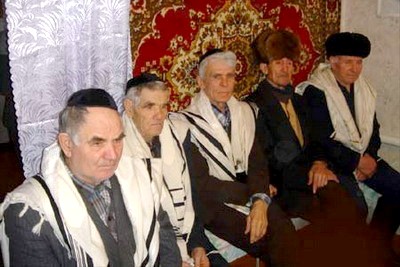
 Subbotnik service in Vysokij,
Russia,
2005.
Subbotniki funeral in Los Angeles, USA, 1930's
See also photos in Armenia and America. For the purposes of discussion on this web site, Subbotniki can be broadly sub-categorized into two groups:
|
|||||||
2. The
Subbotniki Research Report
|
|||||||
The Subbotniki Research Report with photographs, maps bibliography and citations of additional resources and references, by William Abram Aldacushion (Алдакушин), July 2000 — webmaster of this site. Bill is a descendant of the dissolved Pryguny-Subbotniki congregation in Los Angeles. Also available in PDF
version (2.8 MB)
|
|||||||
3. Subbotniki in Los Angeles |
|||||||
General
Background and History
|
|||||||
See also Chapter 6 of The Subbotniki Research Report indexed above. |
|||||||
| 115 Subbotniki
known to be buried at Home of Peace Memorial
Park Short history of this Jewish cemetery in East Los Angeles used by the Subbotnik congregation since 1911 with 115 deceased listed with vital statistics, locations, comments and links to gravestone photographs. |
|||||||
The Russians in Los
Angeles By Lillian Sokoloff
included in Studies
in Sociology published by the Southern
California Sociological Society, University of
Southern California Press, March 1918 (Annotated by
Andrei Conovaloff)
|
|||||||
|
In 1971, Los Angeles Subbotnik congregation
dissolves, donates $800 to UMCA Article by Alex Tolmas, Vice President UMCA, 1971. |
|||||||
| The Subbotniki:
Secret Jews of Boyle Heights Article by Rabbi William M. Kramer, PhD — Western States Jewish History, Vol. 35, No. 2, 2000 |
|||||||
| Memories
and
Music Article by Roberto Loiederman — The Jewish Journal of Greater Los Angeles, April 28, 2006 Efforts are underway to restore the Breed Street Shul near where the Subbotnik congregation in Los Angeles once conducted services. |
|||||||
| Couple
celebrates
70 years at ages 89, 92 - Daily Pilot
(Newport Beach, California), November 27, 2007
Updated June 13, 2016 Article about Morris Abram Pivaroff (son of a respected leader in the former Los Angeles Subbotnik community) who maintained some of the basic tenets of his religion within his family upon his marriage to his beloved non-Subbotnik spouse Lillian.
Note: Morris passed away in 2009 at the age of 93. He was born in Los Angeles, graduated from Roosevelt High school, attended the University of Southern California and served in the US Army during WWII. Morris was a star tennis player in his day who once defeated the legendary Bobby Riggs. His live-long for tennis culminated in the dedication of the "tournament" tennis court at Loyola Marymount University in Los Angeles.* Morris' professional life included careers in banking and real estate. Lillian passed away in 2016 at the age of 98. |
|||||||
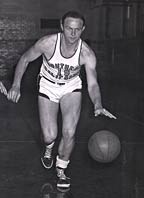 Coach
Abram "Abe" Abram Androff Coach
Abram "Abe" Abram Androff
Abe Androff (May 13, 1921 - April 5, 2012) was the son of one of the founders and elders of the Subbotnik congregation in Los Angeles and provided valuable input and perspective for the content of this web site. His father Abram (Sr.) was instrumental in arranging for the Subbotniki to be buried in the Home of Peace Memorial Park as documented above. Abe was a basketball star at Lincoln High School and the University of Southern California, a US Army Air Corp flight instructor during WWII, appeared in a cameo role in movie The Jackie Robinson Story, and became a legendary basketball coach and educator at Glendale College in California. In 2005 Abe was inducted into the Glendale College Athletic Hall of Fame.
|
|||||||
Relationships with Molokans |
|||||||
See also Chapter 6 of The Subbotniki Research Report indexed above. |
|||||||
| Judaizers Encyclopedia Judica
|
|||||||
A Christianized Tribe of
Jews near the Caspian Sea. Article appearing in
Sacramento Daily Union on January 9, 1873
NEW! item added July 7,
2014
|
|||||||
| Some
Subbotniks
Immigrated to America Together with Molokans:
The
two sects shared routes, ports-of-entry and
sometimes traveled together on same ships. Two Subbotnik Families
Sail to America with Molokans in
1905 - Travel Journal
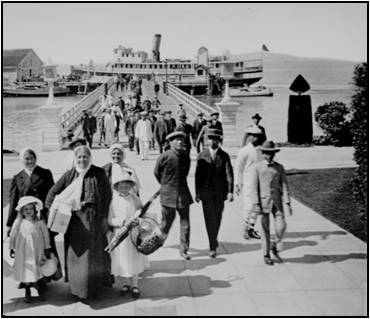 Passenger List of Molokans
and Subbotniks Arriving San Francisco on
August 3, 1905 Passenger List of Molokans
and Subbotniks Arriving San Francisco on
August 3, 1905 Two Subbotnik families (Plushnikoff and Moiseve) traveled with a larger group of Russian Molokan immigrants from the Trans-Caucasus Region of the Russian Empire to Los Angeles via the Panama Canal and San Francisco in 1905. Members of these two families are buried in the Subbotnik sections of the Home of Peace Memorial Park in Los Angeles, California. Newspaper Passenger List and Newspaper Account of Earlier Arrival of Molokans from the Larger Group on June 5, 1905 Another
Account of a Subbotnik Family's
Immigration Experience via Bremen,
Germany and Galveston, Texas in 1907
Subbotnik members of the Pivovaroff family sailed on the SS Frankfort arriving Galveston on September 14, 1907. Members of this two family is also buried in the Subbotnik sections of the Home of Peace Memorial Park in Los Angeles, California. |
|||||||
| Molokans Petition
against "American, Catholic and Subbotniki
bootleggers" in Los Angeles' Flats during
Prohibition Excerpt from doctoral dissertation: Assimilation Problems of Russian Molokans in Los Angeles by Pauline V. Young, University of Southern California, Los Angeles, June 1930
Editor's Note: During Prohibition, there was an exemption granted in the Volstead Act providing for the manufacture and consumption of so-called “ritual wine” used in Jewish and Catholic religious observances (sacrament, weddings, funerals, Seder/Passover dinners, circumcisions, etc.). It was inevitable that some of this product made its way into the broader market for general consumption. See this article posted to the American Jewish Archives for a more in-depth discussion of this topic: "Let Them Drink and Forget Our Poverty" - Orthodox Rabbis React to Prohibition by Hannah Sprecher |
|||||||
| Ocherki
po
istorii russkoi kul'tury (Essays of the
history of Russian culture) Excerpt translated from: Miliukov, P.N., Volume 2 of 3. Moscow. Reprinted 1994. Pages 126-7. [Original published in 1942.]
|
|||||||
| Early Jumper
Leaders Criticize Subbotniki, original
Molokans and the Russian Orthodox Church. Comments on 2 passages from the Dukh-i-zhiznik religious text: Book of the Sun: Spirit and Life. in which a Prygun leader in Russia, M.G. Rudomyotkin, scorns the Subbotniki, Molokane, and all the "666 false faiths." |
|||||||
| 70 Molokan families
converted to Judaism in Saratov, Russia,
before 1925. 1946 interview with Mrs. Clara Adamovna, whose Molokan family all became Jews.
|
|||||||
| The Ukrainian
Stundists and Russian Jews: a collaboration of
evangelical peasants with Jewish intellectuals
in late imperial Russia Paper by Sergei Zhuk (Ball State University) presented by at the 5th International Postgraduate Conference held at the School of Slavonic and East European Studies, University College London, 2008
|
|||||||
4. General Background Information and Research |
|||||||
Comprehensive Books and Research Reports |
|||||||
Gentile
Reactions
to Jewish Ideals - With Special Reference to
Proselytes by Jacob S. Rasin,
Published Posthumously under the Editorship of
Herman Halperin, Philosophical Library, New york,
1953 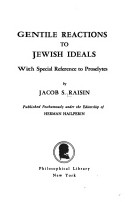 This
comprehensive and seminal work is available in many
libraries. Used copies can be found for sale
on several on-line
book
stores. Pages 705 -723 deal with the origin on
Subbotniki and discuss the motivation of
several individuals for converting to these beliefs. This
comprehensive and seminal work is available in many
libraries. Used copies can be found for sale
on several on-line
book
stores. Pages 705 -723 deal with the origin on
Subbotniki and discuss the motivation of
several individuals for converting to these beliefs.
Click here to open a PDF containing a scan of some sample pages. |
|||||||
| Judaism and
"Jewishness" as Other in 19th Century Russia:The
Conscription/Conversion Policy of Nicholas I
(now longer available online) Thesis by Joey Bacal, Department of Sociology & Anthropology, Lewis & Clark College — July 27, 1997 (Copies of Senior Theses can be found archived in Watzek library and in the department office. |
|||||||
Highlanders - A
Journey to the Caucasus in Quest of Memory
Book by Yo'av
Karny, New York, 2000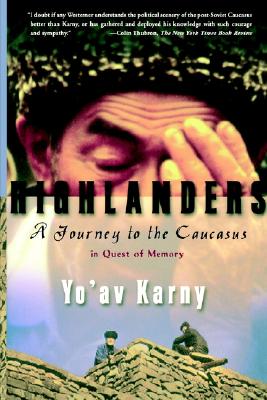 In
Highlanders, Yo'av Karny offers a better
understanding of a region described as a "museum of
civilizations," where breathtaking landscapes join
with an astounding human diversity. Karny has spent
many months among members of some of the smallest
ethnic groups on earth, all of them living in the grim
shadow of an unhappy empire. In
Highlanders, Yo'av Karny offers a better
understanding of a region described as a "museum of
civilizations," where breathtaking landscapes join
with an astounding human diversity. Karny has spent
many months among members of some of the smallest
ethnic groups on earth, all of them living in the grim
shadow of an unhappy empire.
This journey included a 1992 and 1995 visit with the the Subbotniki communities in Yelenovka (Sevan), Armenia and Privolnoye, Azerbaijan which are documented in his book. Click here to peruse preview sections of this work on Google Books. |
|||||||
|
Субботники
(Иудействующие) by Abraham
Shmulevich and Mark Kipnia as it appear online in
Notes of Jewish History, Number 1 (50), January
2005 Subbotniki
(Judaizers) - rough,
unofficial English translation (PDF)
This article presents a concise history of the Subbotnik movement on Russia and concludes with a classification of the various factions or branches of Subbotniki
|
|||||||
Heretics
and
Colonizers: Forging Russia's Empire in
the South Caucasus by Dr. Nicholas B.
Breyfogle, Professor of
History, Ohio State University 2005
book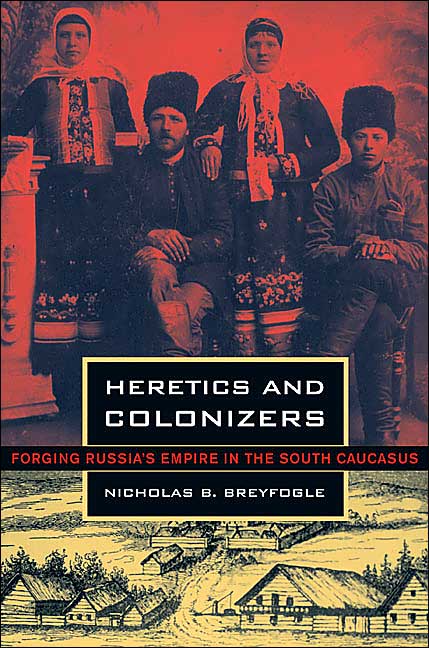 From
his 1998 PhD thesis examining how the “harmful
sects” (Molokans, Doukhobors, Sabbatarians) were
resettled to the Caucasus and their interaction
with each other, often changing membership for
privileges. From
his 1998 PhD thesis examining how the “harmful
sects” (Molokans, Doukhobors, Sabbatarians) were
resettled to the Caucasus and their interaction
with each other, often changing membership for
privileges.
|
|||||||
The Historical
Parameters of Russian Religious Toleration
Paper by Dr.
Nicholas B. Breyfogle, Professor of
History, Ohio State University for The National
council for East European Research - July 27,
2001
|
|||||||
| The Subbotniks
(PDF) Article by Velvl Chernin published by The Rappaport Center for Assimilation Research and Strengthening Jewish Vitality, Bar Ilan University - Faculty of Jewish Studies, 2007 "The following survey is based on fieldwork conducted between the years 2003–2005. It relates only to Subbotnik converts to Rabbinic Judaism. Karaite Subbotniks {including Molokan Subbotniki}will be referred to only when in contact with Subbotnik converts. |
|||||||
| Subbotnik Jews as a
sub-ethnic group Article by Velvl Chernin published on the Euro-Asian Congress web site on February 18, 2011 - The Israeli researcher Velvl Chernin reviews the current state of the communities that still exist in the post-Soviet space. This article provides an update to the current status of Subbotniks following the five-part regional breakdown of the preceding article by the same author. This article contains a very extensive bibliography that should be useful to any one studying this religious sect. |
|||||||
| Государевы
вольнодумцы.
Загадка Русского Средневековья,
В. Г. Смирнов, Москва, 2011 Sovereign Freethinkers. A Riddle of the Russian Middle Ages, by V. G. Smirnov, V.G. Moscow, 2011. Heresy "Judaizers" is considered one of the most mysterious phenomena of the Russian Middle Ages. Many historians have wondered how in such a purely Orthodox country — Russia in the XV century — could have a heretical movement that seized the highest circles of power, sow confusion in the hearts of ordinary people and culminating indicative executions in urban areas? Historian and writer Victor Smirnov tries to impartially understand this delicate episode of Russian history, where politics is closely linked up with religion. |
|||||||
Research by the Russian Scholar Aleksandr L'vov |
|||||||
| E-mail from Dr.
L'vov, June 1, 2005 Alexander L'vov specializes in research about the religion of Jews and Subbotniki at the Center for Jewish Studies, European University, St. Petersburg, Russia. Alexander’s web site: Researching the Russian Jew
|
|||||||
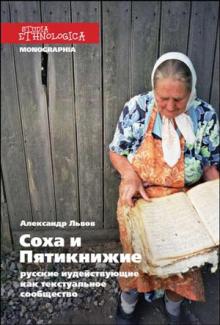 Sokha i Piaitiknizhie. Russkie Iudeistvuiushchie kak Tekstual`noe Soobshchestvo (Russian summary
page by the author)
A Wooden Plow
and Pentateuch. The Russian Judaizers
as the Textual Community
(English summary
page by the author)
by Alexander L'vov, Publishing house of the
European University at St. Petersburg, Russia 2011.
This monograph studies cultural traditions of Russian Judaizers (Subbotniks) in the second half of the 18th – 20th centuries. It describes the history of Old Russian sects, the Subbotniks as well as the Doukhobors and Molokans, and analyzes the role of textuality in Russian and Jewish cultures.
|
|||||||
Different, but not
Quite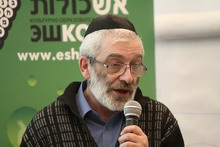 "Among the numerous cultural
theories, there is this: In order to come closer
to understanding the essence of culture is much
more important to study its marginal
manifestations, rather than mainstream.
That is why the Eshkolot project
with the support of AVI CHAI
Foundation, studied three groups, at the
fringes of Judaism (Spanish Marranos, Sabbatarians
and Subbotniki). Alexandr L'vov discussed his
experience and theories about the Subbotniki and
with this project. His comments are summarized in a
report on booknik.ru "Among the numerous cultural
theories, there is this: In order to come closer
to understanding the essence of culture is much
more important to study its marginal
manifestations, rather than mainstream.
That is why the Eshkolot project
with the support of AVI CHAI
Foundation, studied three groups, at the
fringes of Judaism (Spanish Marranos, Sabbatarians
and Subbotniki). Alexandr L'vov discussed his
experience and theories about the Subbotniki and
with this project. His comments are summarized in a
report on booknik.ru
|
|||||||
| Strategies of
Constructing a Group Identity: the Sectarian
Community of the Subbotniki in the Staniza Novoprivolnaia
Article by Sergey Shtyrkov, Folklore, Vol 28, Dec. 2004, page 91
|
|||||||
| Jews
and Subbotniks: History of impact and stereotypes
of perception Paper by A. L'vov, presented July 24, 2002, at the 7th European Association or Jewish Studies (EAJS) Congress: "Jewish Studies and the European Academic World"
|
|||||||
| Иудействовать
и
молоканить недозволено или об особенностях народной герменевтики Страница Александра Львова Judaizers and Molokans are Unlawful or, |
|||||||
| Геры и субботники
— «талмудисты» и «караимы» Страница Александра Львова Gery and Subbotniks — “Talmudists and Karaimy” (.pdf) |
|||||||
| Русские
иудействующие:
проблемы, источники и методы исследования Страница Александра Львова Russian Judaizers: Problems, sources and methods of research (rough English translation) Article by Alexander L’vov |
|||||||
See
also Chapter
4
of The Subbotniki Research Report indexed
above.
|
|||||||
| Personal
Reminiscences and Impressions of historian N.
Kostomarov while exile in Saratov
as published in The Russian Peasantry: Their Agrarian Condition, Social Life and Religion by S Stepniak, 1905 (See section starting on bottom of page 324}
|
|||||||
| The Sabbatarians of
Hungary by W. Bacher, The Jewish Quarterly Review, July 1890
|
|||||||
| BIBLE:
Russian
and Ukrainian, Jewish Virtual Library
|
|||||||
| Holy Dissent: Jewish and
Christian Mystics in Eastern Europe By Glenn Dynner, 2011
|
|||||||
Miscellaneous References to Origins of the Subbotniki |
|||||||
| The
Sabbatarians of Hungary by W. Bacher, The Jewish Quarterly Review, July 1890
|
|||||||
| Judaizers Encyclopedia Judica
|
|||||||
| The Ukrainian
Stundists and Russian Jews: a collaboration of
evangelical peasants with Jewish intellectuals
in late imperial Russia Paper by Sergei Zhuk (Ball State University) presented by at the 5th International Postgraduate Conference held at the School of Slavonic and East European Studies, University College London, 2008
|
|||||||
| Sekstanstvo
(Sectarian) Bodies: Judaizing
Sects A classification of sectarian bodies that appears on the The Byzantine Forum - Discussing the Christian East sponsored by the Byzantine Catholic Church in America. posted on July 13, 2008.
|
|||||||
| A
Crash Course on the Subbotniki Article by Anne Herschman in Kulanu, Volume 9, Number 3, Autumn 2002, page 13. (Saved at Internet Archive) (PDF)
|
|||||||
Where
Is
the True Church? Information on Churches and
SectarianismPart II: Sects and Heresies in Russia, by Bishop Alexander (Mileant)
|
|||||||
|
|||||||
The Sabbatarian Context |
|||||||
| General
Background Information on Sabbatarianism The term Sabbatarian generally refers Christians who observe the Sabbath from sundown Friday to sundown Saturday rather than Sunday and/or those who follow of the Mosaic laws and traditions as a dominant part of the group's religious practices and observances. This section of the Subbotniki Information Exchange web site is dedicated to exploring and understanding general information relating to Sabbatarianism in order to place the Subbotniki within this context. |
|||||||
| The weekly Sabbath:
is it to be Saturday or Sunday?
From the ReligiousTolerance.org
website managed by the Ontario Consultants on
Religious Tolerance Since the name or label given to the Subbotniki is derived from the Russian word for Saturday to highlight the difference in their observance of the Sabbath from the Russian Orthodox Church, this web article provides a useful background perspective on this distinguishing issue of religious observance.
|
|||||||
5. Subbotniki Around the World |
|||||||
| Armenia | |||||||
|
|||||||
| Highlanders
-
A Journey to the Caucasus in Quest of Memory Book by Yo'av Karny, New York, 2000 In Highlanders, Yo'av Karny offers a better understanding of a region described as a "museum of civilizations," where breathtaking landscapes join with an astounding human diversity. Karny has spent many months among members of some of the smallest ethnic groups on earth, all of them living in the grim shadow of an unhappy empire. This journey included visits in 1992 and 1994 with the the Subbotniki community living in Yelenovka (now called Sevan), Armenia.
|
|||||||
| The
Last
of the Saturday People Article by Frank Brown, The Jerusalem Report. Nov. 19, 2001. pg. 72 |
|||||||
| Jews in Armenia:The Hidden Diaspora
(PDF) Thesis/article by Vartan Akchyan (2006, contact in 2024)
|
|||||||
| Jews
in Armenia: The Hidden Diaspora Thesis/film by Vartan Akchyan 2002, DVD/video, 25 minutes, $46
|
|||||||
| Small community
in Armenia strives to preserve its heritage
"Round the Jewish World" article by Yasha Levine, JTA. Sept 7, 2006.
|
|||||||
| Jewish? No, We’re
Subbotniks. Welcome to Our Synagogue. Russian
Sect Practices Judaism — In a Way
By Maxim Edwards Published July 13, 2014 by The Jewish Daily Forward 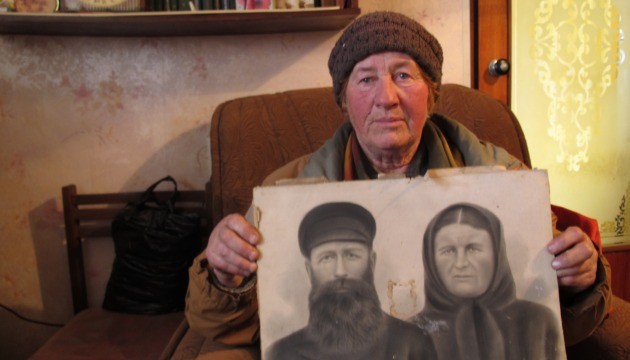
|
|||||||
Australia |
|||||||
 Editor's note: Although the Australian community organization referenced in his section uses the name "Subbotnik," participation is not exclusive to Subbotniki as defined in the rest of this web site, and there is no evidence that Subbotniki actually participate or not. The items are included here only for general information and completeness. Subbotniks Melbourne Community "Welcome to Subbotnik Melbourne Community introducing monthly Shabbat Dinners for the Russian-Speaking (and Russian-feeling) Jews in Melbourne!" Also on Facebook: https://www.facebook.com/pages/Subbotnik/656128024516542
|
|||||||
| A Russian Shabbat Article by Sarah Bendetsky in J-Wire ( Jewish Online News from Australia, New Zealand and world-wide) — April 27, 2015
|
|||||||
Azerbaijan |
|||||||
|
|||||||
| Expedition
to
Azerbaijan in June 1997 Article by V.A.Dymshits — Petersburg Judica. Analysis of 2 Jewish-like villages in Azerbaijan — 1997 Improtex Travel - a private group tour operator in Azerbaijan offering ethnographic excursion in settlements of former Russian immigrants-sectarians: Chukhur Yurd, Hilmilli and Astrakhanovka / Gizmeydan / - Molokans, and also in Nagarakhana / Maryevka, Kirovka / - Subbotniks and baptists. |
|||||||
| Highlanders - A
Journey to the Caucasus in Quest of Memory Book by Yo'av Karny, New York, 2000 In Highlanders, Yo'av Karny offers a better understanding of a region described as a "museum of civilizations," where breathtaking landscapes join with an astounding human diversity. Karny has spent many months among members of some of the smallest ethnic groups on earth, all of them living in the grim shadow of an unhappy empire. This journey included
a 1995
visit with the the Subbotnik community
living in Privolnoye, Azerbaijan.
|
|||||||
Privolnoye
village
as we remember it (Rough
translation into English)
Includes personal video of a walk through the village of Privolnoye in 2007 including a visit to the cemetery/ |
|||||||
| Improtex Travel - a private group tour operator in Azerbaijan offering ethnographic excursion in settlements of former Russian immigrants-sectarians: Chukhur Yurd, Hilmilli and Astrakhanovka / Gizmeydan / - Molokans, and also in Nagarakhana / Maryevka, Kirovka / - Subbotniki and baptists. | |||||||
| Strategies
of
Constructing a Group Identity: The Sectarian
Community of The Subbotniki in the Staniza
Novoprivolnaia by Sergey Shtyrkov of Minsk, Belarus. The article appears as a PDF on the Estonian Folklore web site. The paper considers mechanisms of identity constructions based on field recordings made in 2000 with members of the Subbotnik community from Privolnoye and Navtlug, Azerbaijan after they emigrated and resettled in the Stavropol region of southern Russia.
|
|||||||
Belarus |
|||||||
|
|||||||
| The
Ageyev
Family Web link contributed site by Ilan Guy (Ageyev), Ashdod, Israel
|
|||||||
Researching
Family
History in Subbotniki Communities of Kemerovo or
Bolotnoye, Russia
|
|||||||
| The
Kalmyk-Cossack
Subbotniki: "The Khan's Warriors" convert
while living in Belarus Contributed by Dror Vaikhansky, Mishmar Haemek, Israel dvi@mh.org.il November 2013
|
|||||||
Bulgaria |
|||||||
|
|||||||
| The Sabbatarians of Hungary by W. Bacher, The Jewish Quarterly Review, July 1890
|
|||||||
France |
|||||||
| Vichy Law and the Holocaust
in France written by Richard H. Weisaberg in 1996. {Vichy refers to the
puppet government that administered the parts of
France that were not formally occupied by Nazi
Germany during World War II. The Vichy government
attempted to follow some form of constitutional
law when it came to determining who was to be
considered Jewish for purposes of exclusion and
eventual deportation. }
Four Subbotniki
were living in France at the time of the start
of World War II. The Vichy Council General on the
Question of Jews (CGQJ) first had considered them
to be Jews. A CGQJ official named Ditte maintained
that
A lawyer listed as LaPaulle represented the Subbotniks in an appeal to keep the Subbotniks from being considered Jews although they practiced the Jewish religion. In making his case, Lawyer LaPaulle cited the precedent of Russian law that had exempted Subbotniks from Soviet anti-Semitic measures although acknowledging that the group had "Judaizing tendencies.” His argument stressed the religious distinctions between Subbotniks and Jews. LaPaulle professed:
|
|||||||
Georgia |
|||||||
|
|||||||
| The
Sabbatarians
of Hungary by W. Bacher, The Jewish Quarterly Review, July 1890
|
|||||||
Iran
(Persia)
|
|||||||
|
|||||||
| Light
Through
the Shadows: The True Life Story of Michael
Simonivitch Beitzakhar Excerpts about Subbotniki, Molokane, Pryguny, and Baptisty from Russia in Persia/Iran. Beitzakhar immigrated with Spiritual Christian to Los Angeles about 1950, and served as the pastor of the Russian Seventh Day Adventist Church, Glendale CA, for about 40 years. Translated and Edited by Daniel V. Kubrock [from Beitzakhar's Russian manuscript] — 1953. |
|||||||
Israel |
|||||||
|
|||||||
| Russian
Jews who don't drop out
(PDF) Article by Carl Alpert in The New Jersey Jewish Standard— July 31, 1987
|
|||||||
| Cheese
to
Please Article by Ava Carmel in The Jerusalem Post — Jerusalem, Aug 9, 1991
|
|||||||
| A
time to remember: The Subbotniki of Russia
(PDF) Article by David C Gross in The Jewish Week — NY, Aug. 23-29, 1991
|
|||||||
| An
Early
Russian Immigrants' Farm: Subbotniks Brave
Malaria in Hila Swamp Article by Aviva Bar-Am in The Jerusalem Post — Jerusalem, Sept. 26, 1991 |
|||||||
| Rejected
Article by Yossi Klein Halevi in The Jerusalem Report — Aug. 21, 1997
|
|||||||
| Abandoned
in
the Jordan Valley Article by Ari Ben Goldberg in The Jerusalem Report.— Nov. 19, 2001
|
|||||||
| The
Dubrovin
Farm: The Subbotniks
Gems in Israel: Spotlighting Israel's Lesser Known Tourist Attractions and Travel Sites, the Gems April/May 2000. Map
|
|||||||
Subbotnik Russian
prayer book at Beit Shemesh, Israel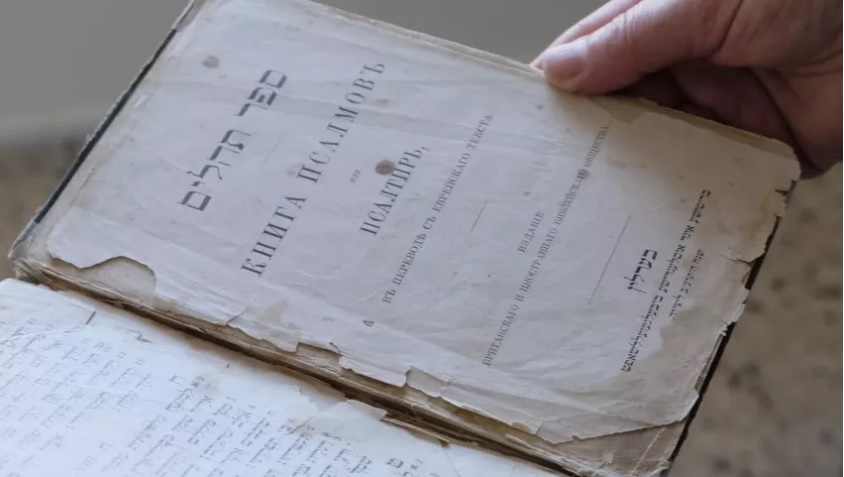 Photo of a prayer book brought from Russia to Israel by Subboniki. Though the photo nothing to do with this story, it is the first online image of such a book, and tells us that some Subbotniki live just west of Jerusalem. |
|||||||
| Israel
takes up the repatriation of "Subbotniks"
News agency Cursor: News of day — Mar. 22, 2005 Израиль приступает к репатриации «субботников» Информационное агентство Cursor: Новости дня — Обновлено 22.03
* Vysokij is a vilage in Voronezh Oblast, Russia and is highlied in a separate Vysokij section below. |
|||||||
| Saving
Russia’s
Subbotnik Jews Jewish World — May 22, 2005:
|
|||||||
| Panel: Bring in
10,000 Subbotniks Article by Nina Gilbert in The Jerusalem Post — June 21, 2005
|
|||||||
| Russia's New
Refuseniks Blog entry on Think-Israel Blog-eds Posted by Michael Freund, October 3, 2007 Refusenik: "... individuals, typically but not exclusively Soviet Jews, who were denied permission to emigrate by the authorities of the Soviet Union and other countries of the Eastern bloc." |
|||||||
| The Plight of Subbotniks
Jewish Russian Telegram, November 25, 2008 |
|||||||
| The
Jews
left behind in Russia Thousands of
Subbotnik Jews being refused permission to
move to Israel by Michael Freund Nov 27, 2008 in Israel Opinion
|
|||||||
| Retracing
the
journey of Russian Jewish converts to Israel
Article by Eli Ashenazi appearing on Haaretz.com on January 30, 2012 Descendants of a group of Russian Christians who converted to Judaism and immigrated to Israel 110 years ago remember their ancestors' path.
|
|||||||
| Landver: Russia’s
Subbotnik community should make aliya
Article by Sam Sokol appearing in the The Jerusalem Post - March 10, 2014. Link submitted by Gavin Archard who lives in Israel.
|
|||||||
| Fundamentally Freund: Here come
the Subbotnik Jews Article by Michael
Fruend, The
Jerusalem Post, March 10, 2014 |
|||||||
 Meet the Subbotniks - from
Russia to Israel Meet the Subbotniks - from
Russia to IsraelArticle appearing in Arutz Sheva on December 26, 2014. Article includes link to video describing the background of Subbotniki in Russia and focuses on a group of Subbotniks now living in Beit Shemesh near Jerusalem. The video displays several photographs of Subbotniki living in Russia in early ot mid 20th century.. |
|||||||
| Subbotnik
immigrants from Russia slowly getting
Israel citizenship NEW!
added 31 July 2019 Only 7 Subbotniki from Russia got Israeli citizenship in 5 years, while many wait. Links to recent news articles about Anna L. Bocharnikova, a community leader from Vysokii who migrated to Israel, studied Judaism and passed the test to become an Israeli citizen. Also a related Bocharnikova family history. |
|||||||
Poland |
|||||||
| The Sabbatarians of Hungary by W. Bacher, The Jewish Quarterly Review, July 1890
|
|||||||
| The
Jewish Community in Subotniki by Kazimierz Niechwiadowicz translated by Jan Sekta |
|||||||
Russia |
|||||||
|
|||||||
| History of Religious
Sectarianism in Russia (1860s-1917) A. I. Klibanov. 1966. (translated 1979)
|
|||||||
| Transcaucasia
Added January 18, 2025 Emanu-el : The Jewish News of Northern California (San Francisco) September 4, 1898. page 11
|
|||||||
| Субботники
(Иудействующие) Added
Sept.
27, 2005 Авраам Шмулевич, Марк Кипнис — КЕЭ, том 8, колонка 635-639 (To be translated from Russian.) |
|||||||
| Современное
Состояние
Сектантства в Советской России, English: A modern Condition of Sectarianism in the Soviet Russia, Н.А. Струве.
("Вестник РСХД", 1960 г.) (To be translated
from Russian.) by N.A.Struve. (Bulletin RSHD,
1960); translated in Religion in the USSR, Munich, July
1960, Series 1, No. 59
|
|||||||
ASTRAKHAN OBLAST (PROVINCE) |
|||||||
|
|||||||
| Jewish community of
Astrakhan FJC—The Federation of Jewish Communities of the CIS
|
|||||||
| Hebrews of the
Russian Steppes
Article by Eliezer Schindler in the United Israel World Bulletin, Union, NY Mar-Apr, 1947. The writer of this article, Eliezer Schindler, while a prisoner of war during the first World War, came in close contact with many converts to Judaism of the Kirghiz Steppes in whose midst he spent the greater part of his forty months in Russia.
|
|||||||
From Astrakhan to Galilee,
by Yoav Regev, published in Hebrew by Ahiasaf,
2009 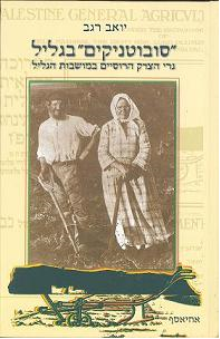 A
review of this book A review of this book
appeared on booknik.ru
(no longer available online) A
review of this book A review of this book
appeared on booknik.ru
(no longer available online)"One day in September 1997, Israeli news began with a terrible message. During the operation, Marines in Lebanon, IDF, Israeli commandos approached the subject of terrorists, "Hezbollah", hit a minefield. In the explosion and died in a shootout twelve men, including commander of the operation, Colonel Yossi Kurakin. The unusual name of the officer who had displayed in his last fight exceptional heroism, has attracted worldwide attention. It quickly became clear that Kurakin - comes from a family of Russian Subbotniks who joined the Jewish people, and moved to Eretz Yisrael more than a hundred years ago."
|
|||||||
| The
Kalmyk-Cossack
Subbotniki from Astrakhan: "The Khan's
Warriors" convert while living in Belarus
NEW! item
added December 27, 2013 Contributed by Dror Vaikhansky, Mishmar Haemek, Israel
|
|||||||
The Historical
Parameters of Russian Religious Toleration
Paper by Dr.
Nicholas B. Breyfogle, Professor of
History, Ohio State University for The National
council for East European Research - July 27,
2001
|
|||||||
SIBERIA & RUSSIAN FAR EAST |
|||||||
|
|||||||
| Святая, как хлеб,
деревенька моя: К
80-летию Бейского района и 175-летию села
Бондарево ХАКАСИЯ Республиканская газета My village is
sacred as bread: On the 80th
anniversary of Beisk region and 175th
anniversary of Bondarev village (English
translation)
KHAKASIYA
Republic Newspaper, Feb. 2004
|
|||||||
| Избранное место на
берегу речки Красноярсий рабочий ; 27.02.2004 ; 36 ; Нина БОГДАНОВА. Chosen
place
on a creek bank (English
translation)
by Nina Bogdanova,
The Krasnoyar
Worker, 27 Feb. 2004, page 36
|
|||||||
| Bondarev
and Tolstoy Excerpts from: Leo Tolstoy and the
Canadian Doukhobors: an historical relationship,
by Andrew Donskov, University of Ottawa, 2005
|
|||||||
|
Юлия Улыбина, СМ Номер
один, Иркутск,
№22 от
9 июня 2005 года (Link contributed by Sergey Petrov - Dept. of Religious Studies, University of Calgary, Alberta, Canada in Mar. 2006.) The Subbotniks of
Zima want to emigrate to Israel
(English translation by WAA)
by Julia Ulybina, The Newspaper "SM Number one", Irkutsk, June, 9th, 2005
|
|||||||
| В
селе Бондарево Бейского района состоялось
открытие памятника Тимофею Бондареву Москва, 06 октября 2005, НИА-Хакасия Dedication of a monument to Timofei Bondarev took place in Bondarev village, Beisk region (English translation) Moscow, 6 October 2005, NIA-Khakasiia |
|||||||
| Толстой
и
Иудино, Илбек Хакасстан — 27 Май 2009
(4 письма Толстого к Bonderev и 10 заметок) Tolstoy and
Iudino, By Ilbek Hakasstan
— May 27, 2009 (4 letters from Tolstoi to Bonderev
and 10 notes
|
|||||||
Researching
Family
History in Subbotniki Communities of Kemerovo or
Bolotnoye, Russia
|
|||||||
| Политические
репрессии в Аскизском районе Хакасии
(1920-1950) 7. «Иудинское дело»
From the Krasnoyarsk Memorial Society, Russian Federation (memorial.krsk.ru) Political repression in Askizsky
district, Khakassya (1920 – 1950) 7. "The
Iudino case":
Subbotnik prisoners during Soviet times
Translation by Andrei Conovaloff, 1 June 2014 (Google document)
|
|||||||
История села
Бондарево
Использована работа Байкаловой Н.И. (ученицы
Бондаревской СОШ) 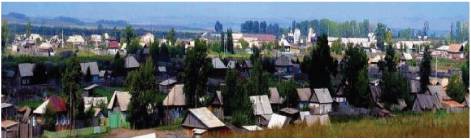
History of
Bondarevo village
From
work by N. I. Baikalova (a student at Bondarevo
School)
- Translaton in Progress.
Contributed by Andrei
Conovaloff, June 2014 |
|||||||
| Точка
на карте. Бондарево (A point on
the map : Bondarevo)
NEW! added June 19, 2017 At Russian travel TV show about Bondarevo, 20 min., produced Mar 17, 2017 - Translaton in Progress.
Contributed by Andrei
Conovaloff, June 2017
|
|||||||
| Бондарев Тимофей Михайлович -
Сибирский философ и просветитель.
Biographies of Timofei
Mikhaiovich Bondarev - Siberian philosopher
and educator. Translated by
Andrei and Tanya
Conovaloff, 2 June 2014.
|
|||||||
3000 Subbotnik Jews in
Irkitsk? Article
by Brian Bloom appearing on Shavei
Israel websiste on October 12, 2015
|
|||||||
| Kalmyk proselyte women
living with Jewish husbands in Russian Siberia
- Information and links provided by Kevin Brook
Editor's note: Although there is no data to substantiate the extension of this phenomenom to other religious exiles, it may indeed be applicable to Subbotniks and other Spiritual Christian males who found themselves in similar circumstances while living in Siberia. Eastern Siberia
Article by Anna E. Peck on page 241 of The Modern Encyclopedia of Religions in Russia and the Soviet Union, Volume 7 edited by Paul D. Steeves, Academic International Press, 1997
Siberia Article in Encyclopaedia Judaica (2008 edition) by Yehuda Slutsky,
Article by Irena
Vladimirsky,
The Jews in
Siberia and the Far East
Article by Michael Evensky, in The Jewish Forum - Volume 4 - 1921 - pages 985-989
For more information
aboiut the background and tracking of the
genetic legacy of these mixed marriages in the
Askennazic Jewish populations see Kevin Brook's
web pages"
|
|||||||
| Точка на карте.
Бондарево (A point on the map :
Bondarevo) |
|||||||
VOLGOGRAD, RUSSIA |
|||||||
| Volgograd Region [Leninsk, Primorsk, Tsarev, Zaplavnoye] | |||||||
| Субботний
исход: В начале прошлого века
жители Заплавного, Царева и Ленинска уходили в
Палестину, недела городa,
16
декабря 2004 (Link contributed by Sergey Petrov — Dept. of Religious Studies, Univ. of Calgary, Alberta, Canada in Mar. 2006. Annotated map site contributed by Ilan Guy (Ageyev), Ashdod, Israel) (Original site no longer available; Translation in-progress) Dr. Petrov now lives in Chili, South America. The Saturday
Outcome: Article in Nedelya-Gorodo
Newspaper, Dec. 14, 2004.
|
|||||||
| What
is
happening in Misrad ha Pnim (again)? Blog by Paul about previous article, Feb. 17, 2005
|
|||||||
| VORONEZH PROVINCE - ILYINKA, RUSSIA | |||||||
| Ilyinka [population 100, Voronezh province, 1991] | |||||||
| The Last Jews of
Ilyinka The Jerusalem Report — Feb. 14, 1991
|
|||||||
| Daas Torah
- an online forum to clarify some of the issues of
Jewish Identity. Subbotnik Jews of Ilyinka are Jews The particular forum thread started on February 11, 2009 explores pro and counter arguments to the principle that all Russian Subbotniki are Jewish and therefore deserve to right to emigrate to Israel. Some sample comments:
|
|||||||
VORONEZH PROVINCE - VYSOKIJ, RUSSIA |
|||||||
|
Vysokij or Высокий
(meaning “tall” or "high") is a village in the
Talovskij district of Voronezh province of Russia.
The village is located 700 km south of Moscow (See
Google map). Vysokij has a
population of around 7,000 and is the home of a
Subbotniki congregation. The city’s name has also
been written in English as Vysokii, Vyshoi or Vysokiy.
|
|||||||
Путешествие в Высокий От Раисы Минаковой, Под редакцией Билла Алдакушина Journey to Vysókij
Contributed by Raisa Minakova (Kaliningrad, Russia), edited by Bill Aldacushion (Fairfax County, Virginia, USA), August 2014 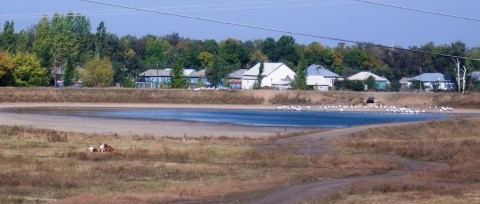 Brief Family History
and three Photo
Albums taken during Raisa's journeys
to the village of Vysokij and visits with her
friends and family living there. Brief Family History
and three Photo
Albums taken during Raisa's journeys
to the village of Vysokij and visits with her
friends and family living there.
|
|||||||
The Forsaken Converts of Russia An account of a visit with the Subbotniki in Vysokij by Eli Bardenstein, Ma'ariv (Sof-shavua Weekend Supplement), November 28, 2008
|
|||||||
| Израильского
раввина послали учить субботников An Israeli rabbi has been sent to {Russia} to learn about Subbotniki (link to rough English translation) Article appearing on izrus.com web site Dec. 17, 2008
|
|||||||
| Russia's
Subbotnik
Jews get rabbi Article appearing on Ynetnews.com on December 9, 2010
|
|||||||
| Cleaning a Jewish Cemetery
in Southern Ruussia Article by Brian Blum, May 29, 2012
|
|||||||
| A
Subbotnik Jewish wedding in Moscow
by Brian Blum, November 11, 2012
|
|||||||
| Subbotnik
Jews
make aliya Article and video appearing on Ynetnews.com on November 21, 2013
|
|||||||
| Russian
Subbotniks Dream of Coming to Isreal
NEW! added June 19, 2017 Article by Mordechai Goldman appearng on Al-Monitor web site on June 9, 2017
|
|||||||
Ukraine |
|||||||
|
|||||||
| The
Ukrainian
Stundists and Russian Jews: a collaboration of
evangelical peasants with Jewish intellectuals
in late imperial Russia Paper by Sergei Zhuk (Ball State University) presented by at the 5th International Postgraduate Conference held at the School of Slavonic and East European Studies, University College London, 2008
|
|||||||
| Subbotniki
carrying
out 'good works' in Transcarpathia Article by Bonne A. Rook, The Journal - News of the Churches of God, May, 2004
|
|||||||
| Visit with Subbotnik family
in Krivoi Rog Article by Michael Freund, Jerusalem Post , January 27, 2016
|
|||||||
| Searching for
Information about Subbotnik Family in
Western Ukraine NEW! added March 15, 2017 Contributed by Isa Milman, Victoria, British Columbia, Canada imilman@shaw.ca March 2017
|
|||||||
Uruguay
|
|||||||
| Russians in Uruguay Since 1900 hundreds of thousands of Russians fled their homeland and resettled around the world. Many were members of religious groups that rejected the official Orthodox faith and were harassed and punished. This is a summary index of the ethno-religious groups that relocated to Uruguay from Russia — New Israel, Molokane, Pryguny, Maksimist, Sabbatarians, Sons of Freedom, Old Believers, and German Mennonite Brethren. Each has separate villages and religions. |
|||||||
Uzbekistan
|
|||||||
|
|||||||
| UZBEKISTAN:
Believers
are not even allowed to visit each other
Article by Igor Rotar, Forum 18 News Service — Oct. 27, 2005
|
|||||||
6. Other Subbotniki-related Websites |
|||||||
| Subbotniks
on English version of Wikipedia.com Subbotniks on French version of Wikipedia.com Russian History Encyclopedia: Judaizers on Answers.com |
|||||||
7. Contact Information |
|||||||
NOTE: The views represented by the content of external links contained or referenced on this web site are not necessarily those of the Subbotniki.net web site coordinators but are included only to present the wide range of views surrounding the Subbotniki so that all this information can be viewed in context. |
|||||||